Blog
AI Content in SEO: 2025 Ranking of Search Engines by How They Treat It
Table of contents
AI-generated articles, product pages and landing pages are now everywhere. Many marketers still worry that using AI content in SEO will automatically trigger penalties in Google, Bing or other search engines. In reality, each engine has its own balance between encouraging innovation and fighting low-quality, automated spam. This ranking compares the major search engines by how they currently treat AI-assisted content and what that means for a long-term SEO strategy.
What “AI Content in SEO” Really Means in 2025
In this context, AI content in SEO means any page where artificial intelligence helps to research, draft, rewrite or expand text, images or code that eventually gets indexed by search engines. The key point across all major engines is that quality, usefulness and honesty matter more than the specific tool used to write the text.
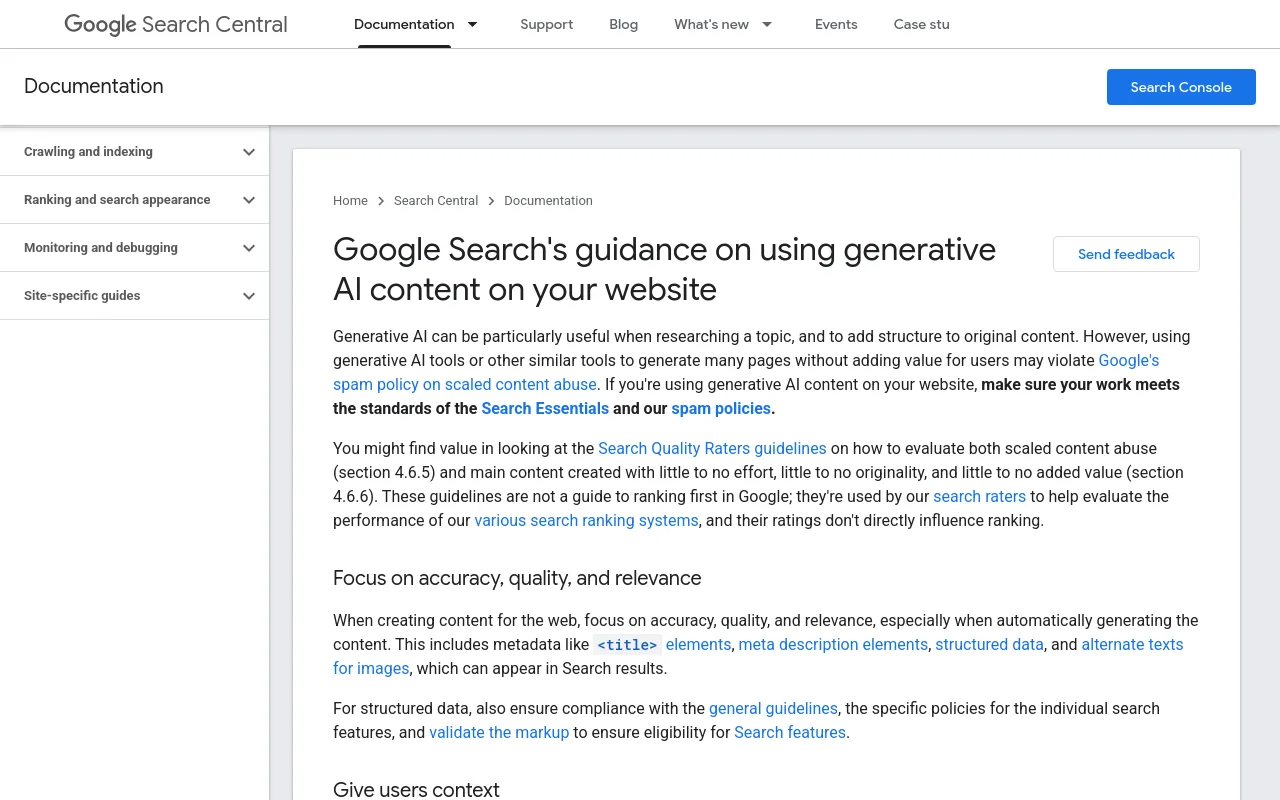
Google’s official documentation explicitly states that automation, including AI, is acceptable as long as the content is not primarily created to manipulate rankings and still follows Search Essentials and spam policies. At the same time, Google has tightened rules against “scaled content abuse” and other forms of unoriginal, mass-produced pages that add little value.
Bing and DuckDuckGo take similar positions: the text does not need to be written by a human from scratch, but it must be original, useful, easy to crawl and aligned with user intent, not just a block of generic machine-generated sentences stuffed with keywords.
In practice, AI is best treated as a powerful assistant: it can help structure long guides, generate first drafts, summarize data and suggest outlines, while humans handle strategy, fact-checking, examples and unique experience.
How This Ranking of Search Engines Was Built
The positions below are based on four practical criteria relevant to AI content in SEO:
- How clear and up to date the official guidelines about AI and automation are.
- How aggressively the engine acts against low-quality or scaled AI content.
- How tightly AI answer products (like AI overviews or chat) are integrated into search.
- What opportunities exist for high-quality, AI-assisted pages to gain traffic and citations.
The result is a pragmatic ranking of the engines that matter most for organic and AI-driven visibility in 2025.
1. google.com – Most Detailed, but Strictest About Scaled AI Spam
Google remains the main reference point for AI content in SEO simply because it still owns the majority of the global search market and sets the tone for many best practices.
On the one hand, Google’s official stance on AI is surprisingly permissive. Search Central makes it clear that helpful content can be created with or without automation, and that AI assistance itself is not against the rules. The real problem is using automation primarily to manipulate ranking or flood the index with thin, repetitive pages.
On the other hand, the last two years brought a series of core and spam updates specifically aimed at unoriginal content, doorway pages and scaled AI-generated text of little value. Case studies from SEO practitioners show that sites relying on massive, low-effort AI pages have been heavily hit, especially during the March 2024 core and spam updates and subsequent actions.
Google also introduced and now enforces a “site reputation abuse” policy, targeting hosted third-party content used for so-called parasite SEO. This has already triggered EU antitrust scrutiny because publishers claim it reduces their traffic and limits how they monetize their sites. Although this policy does not mention AI directly, it shows how seriously Google treats any attempt to scale content purely for ranking, including automated text.
Best Practices for AI Content on Google
To keep AI content in SEO safe and effective for Google:
- Focus on “helpful content” signals. Pages should answer specific user questions better than competitors, with clear structure, examples, and up-to-date information, not just generic paragraphs.
- Avoid scaled content abuse. Do not auto-generate hundreds of near-duplicate location pages, product pages or programmatic posts without real added value.
- Show experience and expertise (E-E-A-T). Where relevant, add first-hand data, screenshots, experiments, case studies and bylines that demonstrate real-world experience.
- Use AI for drafting, humans for editing. Combine AI drafts with human editing, fact-checking and optimization; independent analyses of thousands of pages suggest that edited AI-assisted content can perform well when it is genuinely useful.
- Keep technical SEO clean. Ensure fast loading, proper internal linking, clear headings and structured data so that Google can easily understand and evaluate the content.
In short, Google is the strictest search engine when AI content is used as a shortcut to mass-produce pages, but it is also the most rewarding when AI is used to create deeply helpful resources.
2. bing.com – AI-Forward and Closely Aligned With Traditional SEO
Bing plays a double role: it is both a classic search engine and the main index behind Microsoft’s AI assistants such as Copilot and Bing Chat. Many AI answer experiences seen in Windows, Edge or other Microsoft products are powered by Bing’s index, so optimizing for Bing directly influences AI visibility as well.
The public Bing Webmaster Guidelines emphasize long-standing anti-spam rules: no cloaking, no keyword stuffing, no manipulative link schemes and no scraped or automatically generated content that adds little value. Automatically generated text is treated as a problem only when it is thin, misleading or clearly there to trick the algorithm rather than help users.
At the same time, Microsoft’s own AI search optimization guides highlight that traditional SEO fundamentals — crawlability, good metadata, internal linking and backlinks — are still the starting point. On top of that, content must be clear, modular and structured so AI systems can easily extract answers and cite them.

Best Practices for AI Content on Bing
For AI content in SEO targeting Bing and Bing-powered AI products:
- Follow the guidelines on automatically generated content. Avoid low-effort machine text; combine AI with original insights, data and examples that do not exist elsewhere.
- Structure content for AI selection. Use clear headings, bullet lists and Q&A sections to make it easy for AI systems to lift concise answers into chat responses.
- Use Bing Webmaster Tools and IndexNow. Submit sitemaps, monitor crawling and fix technical issues; Microsoft explicitly recommends these steps for better AI answer visibility.
- Maintain clean backlink and UX signals. Like other engines, Bing pays attention to reputable backlinks, page speed and user experience, all of which support AI-driven visibility.
In practice, Bing is slightly more forgiving than Google for sites that use AI content at scale, but pages that are clearly unhelpful or spammy can still be filtered or de-ranked.
Read the official Bing Webmaster Guidelines before launching any large-scale AI content project.
3. duckduckgo.com – Privacy-First, Quality-Driven Results
DuckDuckGo has grown as a privacy-focused alternative that does not track users. It pulls results from hundreds of sources, including its own crawler and Bing, and then applies its own ranking signals.
The engine does not have a separate, detailed policy on AI content. Instead, official and third-party documentation stresses classic SEO values: high-quality and relevant content, strong backlinks and honest on-page optimization. Because DuckDuckGo partly depends on Bing’s index, any AI content in SEO that performs well in Bing is likely to be rewarded here too.
Best Practices for AI Content on DuckDuckGo
To make AI-assisted content work well in DuckDuckGo’s ecosystem:
- Prioritize genuine relevance over personalization. Since DuckDuckGo does not personalize results based on individual user history, pages must clearly match broad search intent rather than a very narrow persona.
- Strengthen backlink and citation quality. DuckDuckGo has openly stated that high-quality backlinks are one of its key ranking factors.
- Reuse Bing-ready content. Well-structured pages created for Bing’s index and AI systems often carry over effectively to DuckDuckGo.
- Align with privacy expectations. Avoid aggressive tracking scripts and dark-pattern UX; a clean, privacy-respecting setup fits DuckDuckGo’s brand and user base.
Because DuckDuckGo relies strongly on the underlying quality signals from other indexes, it indirectly inherits their expectations about AI content, even if it does not emphasize AI in its own messaging.
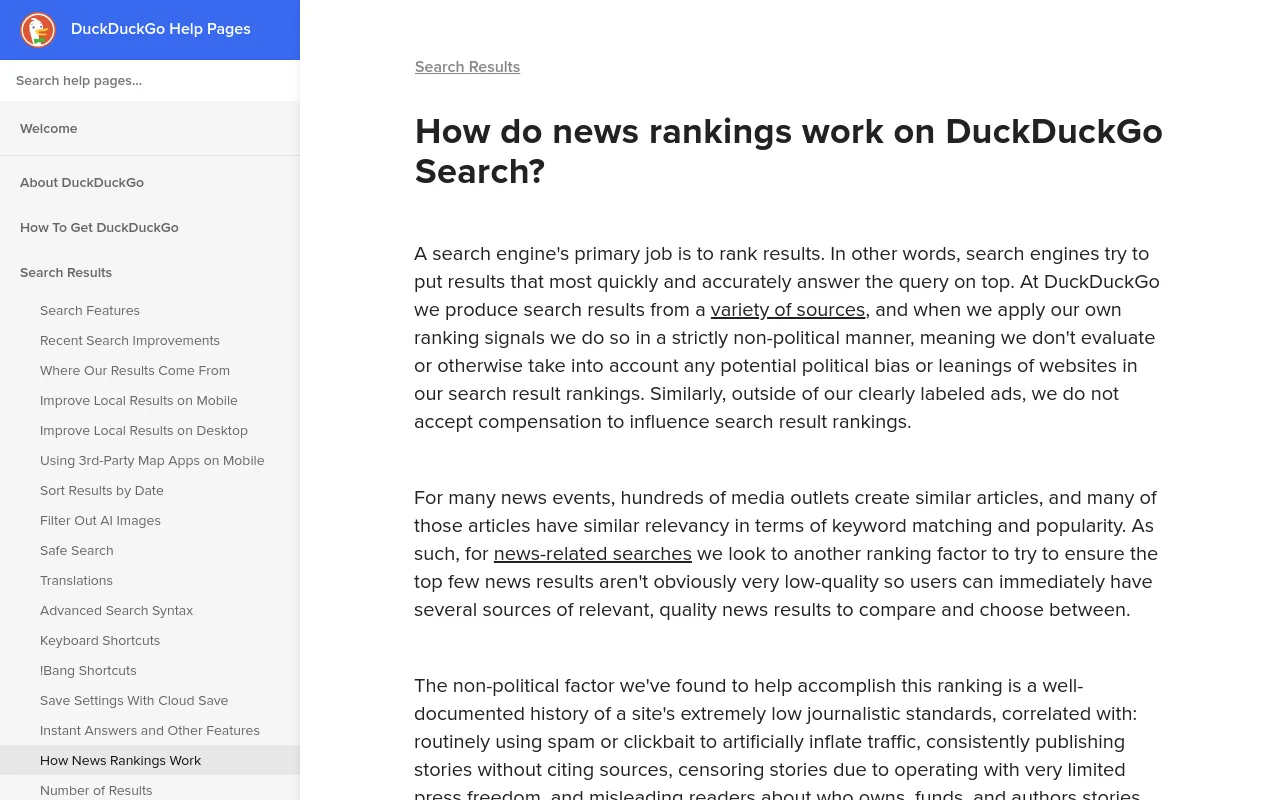
See DuckDuckGo’s explanation of how it ranks news and other results for additional context.
4. Other Search Engines and AI Answer Surfaces
Beyond Google, Bing and DuckDuckGo, there are several smaller engines and hybrid systems:
- Yahoo, Ecosia, Qwant and others often use Bing’s index or a mix of sources, so the same principles for AI content in SEO applied to Bing usually work here too.
- AI meta-search tools and assistants such as various AI browsers, answer engines or aggregators typically rely on Google and Bing indices plus their own models. They select snippets from existing pages based on clarity, authority and freshness.
- Vertical engines (for hotels, e-commerce, code, etc.) may have their own quality guidelines, but most still reward original content, accurate data and strong UX more than any particular writing method.

Across all of these surfaces, the same rule repeats: AI-assisted content can rank and be cited if it is distinctive, helpful and technically easy to parse.
Checklist: Using AI Content in SEO Without Getting Penalized
To close, here is a practical checklist for safely using AI content in SEO across all major search engines:
- Start with intent, not tools. Define the user’s question, search intent and funnel stage first. Use AI only after the strategy is clear.
- Generate, then enrich. Let AI draft outlines, structure and initial copy, but always enrich with original research, examples, screenshots, data or opinions that competitors do not have.
- Edit like an editor, not a proofreader. Rewrite generic AI sentences, remove fluff, adjust tone, ensure factual accuracy and verify citations.
- Guard against scaled content abuse. Avoid pumping out thousands of similar pages with only minor keyword swaps; Google’s spam policies explicitly target that pattern.
- Respect each engine’s webmaster guidelines. Regularly review the documentation for Google and Bing in particular to detect new spam examples or policy changes.
- Optimize for AI answers, not just blue links. Use logical headings, bullet lists, FAQ blocks and concise definitions so AI systems can lift passages into answer boxes and chat replies.
- Measure and iterate. Track organic traffic, impressions, AI-driven referrals and user engagement. When AI-assisted pages underperform, examine whether the underlying content truly helps users better than alternatives.
Review Google’s generative AI content guidance and compare it with Bing and DuckDuckGo recommendations before scaling up any AI-driven content program.
Handled thoughtfully, AI content in SEO is not a shortcut to rankings, but a way to produce more consistent, well-structured and user-focused pages that satisfy both human readers and modern search engines.
About the author
Jamie Brooks
PressBay writer focused on growth loops and SEO for domain-driven media.
Related
Related articles

Content Marketing Strategy for SaaS: A Practical Funnel Map, Topic Engine, and Publishing Cadence
A SaaS (Software as a Service – subscription software delivered online) content marketing strategy is a written system that connects funnel stages to specific content types, with clear distribution and measurement. You map what each stage must achieve (awareness, evaluation, act…
More from the author
Digital PR Outreach for Backlinks: What Actually Earns Links (Data, Assets, Angles)
10 min readDigital PR (Public Relations – earned media outreach) earns backlinks when you offer publishable evidence and a ready-to-use asset that makes a writer’s job easier. Links appear as a byproduct of credible coverage, not as a negotiated “placement,” so the winning pitches are buil…
Broken Link Building: A Step-by-Step Workflow and Outreach Script
12 min readBroken link building works by finding dead outbound links on real pages and offering a better replacement that helps the reader. You earn links by doing genuine maintenance: you fix a problem, and the editor swaps the broken URL (Uniform Resource Locator – the web address) for y…
How to Build a Media List for Digital PR Outreach (Tools, Filters, and Process)
9 min readA strong media list for Digital PR (Digital Public Relations) outreach is a curated outreach database built around relevance, not volume. It combines editorial-fit outlets, the right contact roles, and proof that each target actually covers topics like yours. When done right, it…
Content Marketing Strategy for SaaS: A Practical Funnel Map, Topic Engine, and Publishing Cadence
11 min readA SaaS (Software as a Service – subscription software delivered online) content marketing strategy is a written system that connects funnel stages to specific content types, with clear distribution and measurement. You map what each stage must achieve (awareness, evaluation, act…

Previous article
Link Building in 2026: How to Earn Risk‑Free Links that Actually Move Rankings
Next article